
Why Does Your Body Have Almost No Oil Glands?
Body skin has fewer than 10 oil glands per square centimetre, compared to 400 to 900 on the face, according to Zouboulis et al., Experimental Dermatology, 2008. That structural gap is why no lotion can compensate for what the barrier cannot replenish on its own.
Those oil glands are the engine of the skin barrier. They continuously secrete lipids (oils, ceramides, fatty acids) that form the outermost protective layer. On your face, this replenishment happens all day. On your arms, shins, and torso, it barely happens at all.
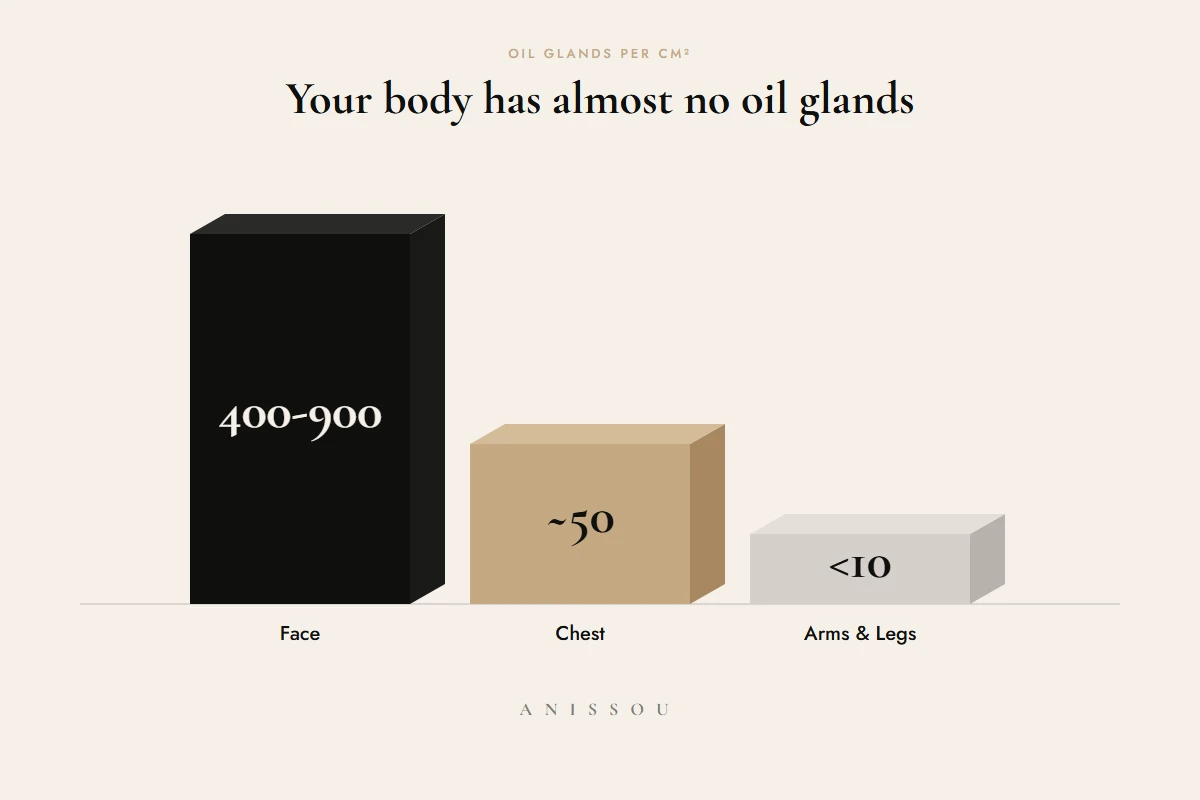
That gap is huge. It means body skin cannot repair its own barrier the way your face can. When it breaks down, it stays broken.
Oil glands do more than produce oil. They continuously secrete a blend of triglycerides, wax esters, squalene, and free fatty acids that form the outermost layer of the skin barrier. On your face, this happens constantly. On your arms, shins, and torso, it barely happens at all. The result is that body skin is structurally exposed in a way facial skin never is.
Every shower makes this worse. Surfactants in body wash strip the residual lipids that do exist on body skin. On the face, the oil glands replenish within hours. On the legs, there is almost nothing to replenish. The skin starts each day already behind, and most body care routines do nothing to change that equation.
Why Is Body Lotion Not Working?
Body lotion is mostly water, and water cannot fix a broken lipid barrier. When the barrier is compromised, your skin loses moisture continuously through the surface. Applying more water on top provides brief relief, then evaporates. The barrier stays broken.
Transepidermal water loss (TEWL) is the continuous escape of water through the outer skin layer when the lipid barrier is compromised. It is the primary measure of how well your barrier is functioning. When TEWL is high, no amount of lotion stops it.
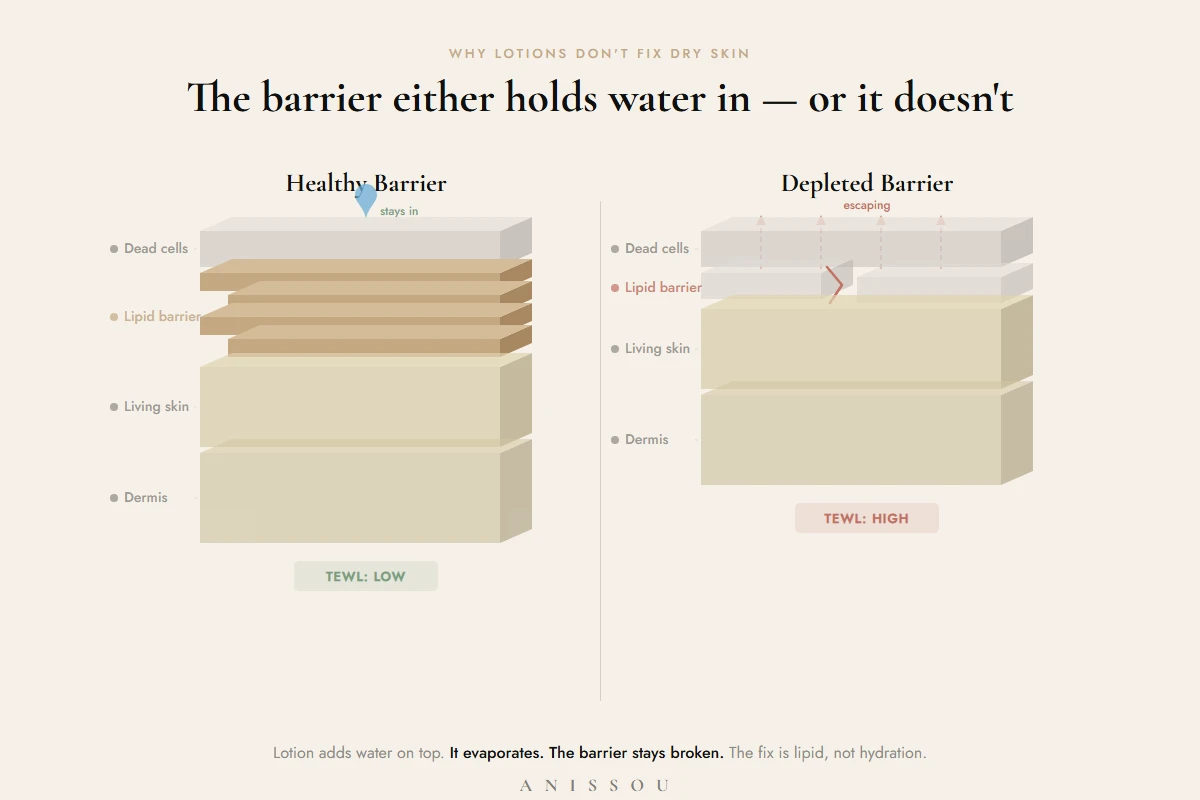
"Lotion adds water on top. The barrier stays broken. You are filling a bucket with a hole in it."
What about glycerin and hyaluronic acid?
These are humectants. They pull water toward the surface of your skin. That sounds helpful, and it is, when the barrier is intact. When it is not, the water they attract just escapes faster. Same hole, more water coming in.
- Lotion is mostly water. It evaporates.
- Glycerin and hyaluronic acid attract water, but cannot hold it in
- None of these fix the barrier itself
Why Does Body Skin Age Faster Than Your Face?
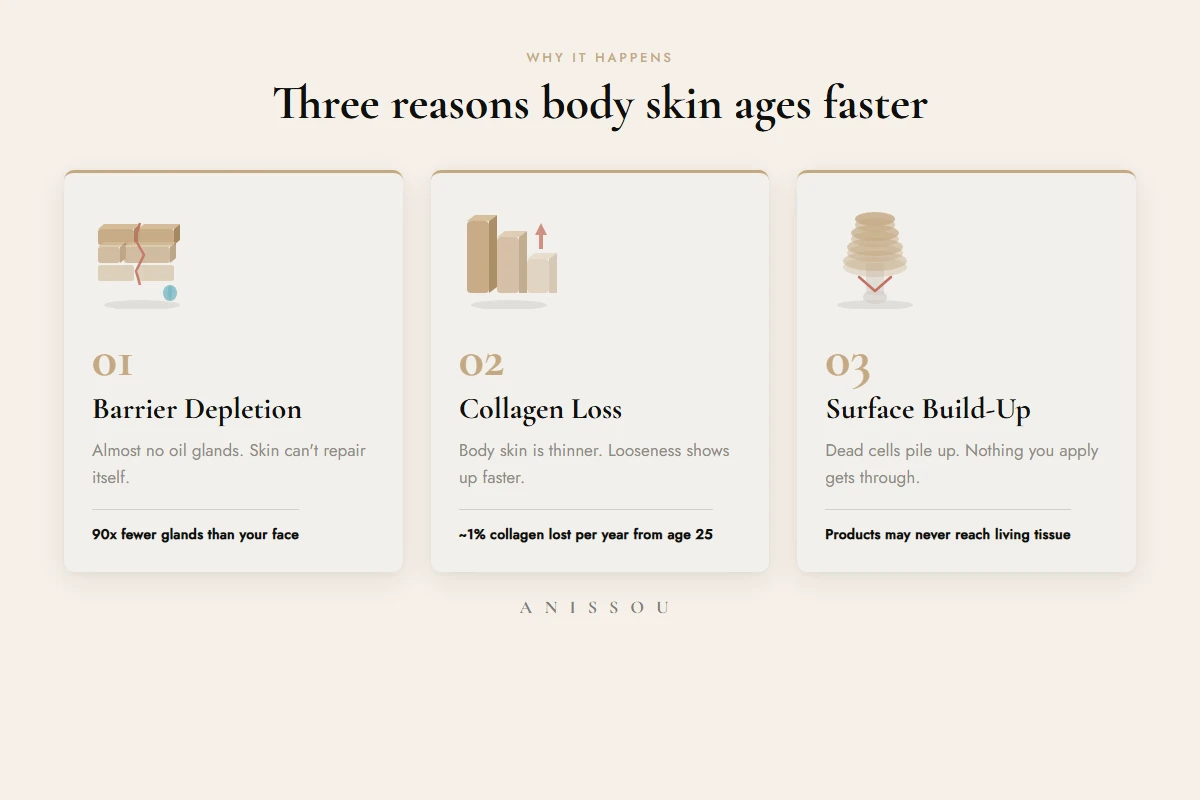
Body skin shows the signs of aging earlier than facial skin because it starts with less structural reserve and receives almost no protective skincare. The mechanisms are the same: barrier depletion, collagen loss, and slower cell turnover. But on body skin, each one hits a lower baseline.
| Face | Body | |
|---|---|---|
| Oil glands | 400-900 per cm² | Under 10 per cm² |
| Self-repair ability | High | Almost none |
| Skin thickness | Thicker | Thinner (inner arm, thighs) |
| Collagen loss shows up | Later | Earlier |
| Cell turnover | Faster | Slower |
Skin loses approximately 1% of its collagen content per year from the mid-twenties onward, according to Varani et al., American Journal of Pathology, 2006. On your face, the skin is thick enough to absorb years of that before it shows. On your inner arm or thigh, the skin was never as thick, so looseness appears sooner.
Barrier depletion
With no oil glands to maintain it, the lipid barrier on body skin degrades incrementally with every wash, every cold day, every hour of low humidity. The depletion is cumulative. By the time most people notice dryness or roughness, the barrier has been compromised for weeks.
Collagen loss
Collagen gives skin its structural density. As it declines with age, skin gets thinner and less resilient. Body skin, particularly the inner arm, abdomen, and thighs, has a thinner starting thickness than facial skin. It reaches the threshold where loss becomes visible earlier, and because most people invest zero collagen-supporting skincare in those areas, there is nothing slowing the process.
Slower cell turnover
Skin renews itself by cycling old cells to the surface and shedding them. On the body, this cycle slows with age. Dead cells accumulate longer before clearing. The surface becomes dull, rough, and less able to absorb anything applied to it. This is why applying oil to unexfoliated body skin often produces minimal results: the product never reaches the living skin underneath.
What Is the Cycle That Keeps Your Skin Dry?
Body lotion keeps failing because it targets the symptom (surface dryness) without touching the cause, which is a broken lipid barrier. Most people repeat the same ineffective routine without realising the tool itself is wrong:
- 1Apply body lotion to dry skin
- 2Skin feels better for a bit
- 3Water evaporates within an hour
- 4Skin is dry again by evening
- 5Repeat the next day
It is not a willpower problem. It is not about how much you apply. It is the wrong tool for the job.
The reason this cycle is so persistent is that lotion does work, briefly. That brief window of relief is convincing enough that most people conclude they just need to apply more, or more often, or find a better formula. The barrier problem never gets addressed because the symptom keeps getting temporarily masked.
There is also a timing problem. Most people apply lotion to dry skin at the end of a day, or after they notice discomfort. By that point, TEWL has been running for hours. A water-based product applied to already-dry skin gives a small burst of surface hydration before the same cycle resumes. Applying after bathing, before the skin surface dries, is more effective. But it is still not a fix. It is a less inefficient version of the same temporary solution.
What your skin actually needs
Ceramides are lipid molecules that form the waterproof structure between skin cells, making up approximately 50% of the stratum corneum's lipid content, according to van Smeden and Bouwstra, International Journal of Molecular Sciences, 2016. When they are depleted, the barrier fails.
Linoleic acid is an omega-6 fatty acid the skin cannot synthesise on its own. It is the direct precursor the skin uses to build ceramide 1 and ceramide 2, the specific ceramides most depleted in dry, compromised skin.
- Lipid-rich oil to replace what the barrier is missing
- Ceramide precursors (linoleic acid) so the skin can rebuild from within
- A clear surface so anything you apply can actually get through
What Is the Three-Step Sequence That Actually Works?
The problem is not just what you use. It is the order. Most people apply oil directly to skin that is covered in dead cells. The oil sits on top and does almost nothing.

Step 1: Soften
A pH-balanced step loosens the bonds between dead skin cells. Think of it as unlocking the surface so it can actually be cleared.
Step 2: Clear
Enzymatic exfoliation removes the dead cell layer without stripping living skin. Now the barrier is exposed and ready.
Step 3: Rebuild
Apply a linoleic-rich oil immediately after. It reaches the barrier directly. Your skin uses linoleic acid as a building block to make its own ceramides, the exact lipid the barrier is missing.
"Skip the sequence and your oil sits on dead cells. Follow it and it reaches living skin."
What Should You Look for in a Body Oil?
Not every oil repairs the barrier. The key is the fatty acid profile.
| Repairs the barrier | Conditions the surface only | |
|---|---|---|
| Main fatty acid | Linoleic (Omega-6) | Oleic (Omega-9) |
| What it does | Helps skin build its own ceramides | Softens the surface |
| Result over time | Barrier gets stronger | Skin needs daily application |
| Example oils | Prickly pear, rosehip, evening primrose | Coconut, sweet almond, marula |
Prickly pear seed oil is 55 to 65% linoleic acid, with a 3:1 ratio of linoleic to oleic, the highest of any common botanical oil, according to Cherif et al., Industrial Crops and Products, 2015. The same study found it contains 150% more tocopherol (the primary antioxidant) than argan oil, which matters when you are treating 20 times the surface area of your face.
For the full breakdown of the tocopherol and linoleic acid profile, read the companion piece: Prickly Pear Seed Oil: Why It Works Differently on Body Skin.
Frequently Asked Questions
Why does my body lotion stop working after a while?
It was never fixing the real problem. Body lotion adds water to the surface. Once that water evaporates, your skin is back where it started. The barrier is still broken. The fix is lipid replacement, not more hydration.
What is the difference between body lotion and body oil?
Body lotion is mostly water. It relieves surface dryness temporarily, then evaporates. A linoleic-rich body oil delivers fatty acids your skin uses to rebuild its own ceramide barrier, addressing the structural cause rather than the symptom. One masks the problem. The other solves it.
Can I use body oil instead of body lotion?
Yes. A linoleic-rich body oil is more effective for dry skin because it delivers ceramide-building fatty acids directly to the barrier rather than adding water that will evaporate. Apply it to slightly damp skin after a shower and results build over two to four weeks.
Why is my body lotion not working?
Body lotion is mostly water. It relieves dryness temporarily, then evaporates. The real problem is a broken lipid barrier that cannot hold moisture in. Until the barrier is repaired with lipid-rich ingredients, the dryness will return no matter how much lotion you apply.
Why does my skin feel dry again so fast after moisturising?
Because lotion is not fixing the barrier. Water escapes through damaged skin continuously (transepidermal water loss). Lotion covers the surface temporarily, then evaporates, and the leak resumes. The only solution is barrier repair with lipid-rich ingredients, not more water on top of a compromised barrier.
References
- 1. van Smeden, J. & Bouwstra, J.A. "Skin barrier function and its relation to the fatty acid profile." International Journal of Molecular Sciences, 2016. https://doi.org/10.3390/ijms17030360
- 2. Elias, P.M. "Skin barrier function." Dermatologic Therapy, 2005. https://doi.org/10.1111/j.1529-8019.2005.00040.x
- 3. Rawlings, A.V. & Harding, C.R. "Moisturization and skin barrier function." Dermatologic Therapy, 2004. https://doi.org/10.1111/j.1396-0296.2004.04s1001.x
- 4. Chérif, A.O. et al. "Chemical composition and oxidative stability of Opuntia ficus-indica seed oils." Industrial Crops and Products, 2015. https://doi.org/10.1016/j.indcrop.2014.09.047
- 5. Lodén, M. "Role of topical emollients and moisturizers in the treatment of dry skin barrier disorders." American Journal of Clinical Dermatology, 2003. https://doi.org/10.2165/00128071-200304111-00002
- 6. Zouboulis, C.C. et al. "Frontiers in sebaceous gland biology and pathology." Experimental Dermatology, 2008. https://doi.org/10.1111/j.1600-0625.2008.00725.x
- 7. Varani, J. et al. "Decreased collagen production in chronologically aged skin: roles of age-dependent alteration in fibroblast function and defective mechanical stimulation." American Journal of Pathology, 2006. https://doi.org/10.2353/ajpath.2006.051302