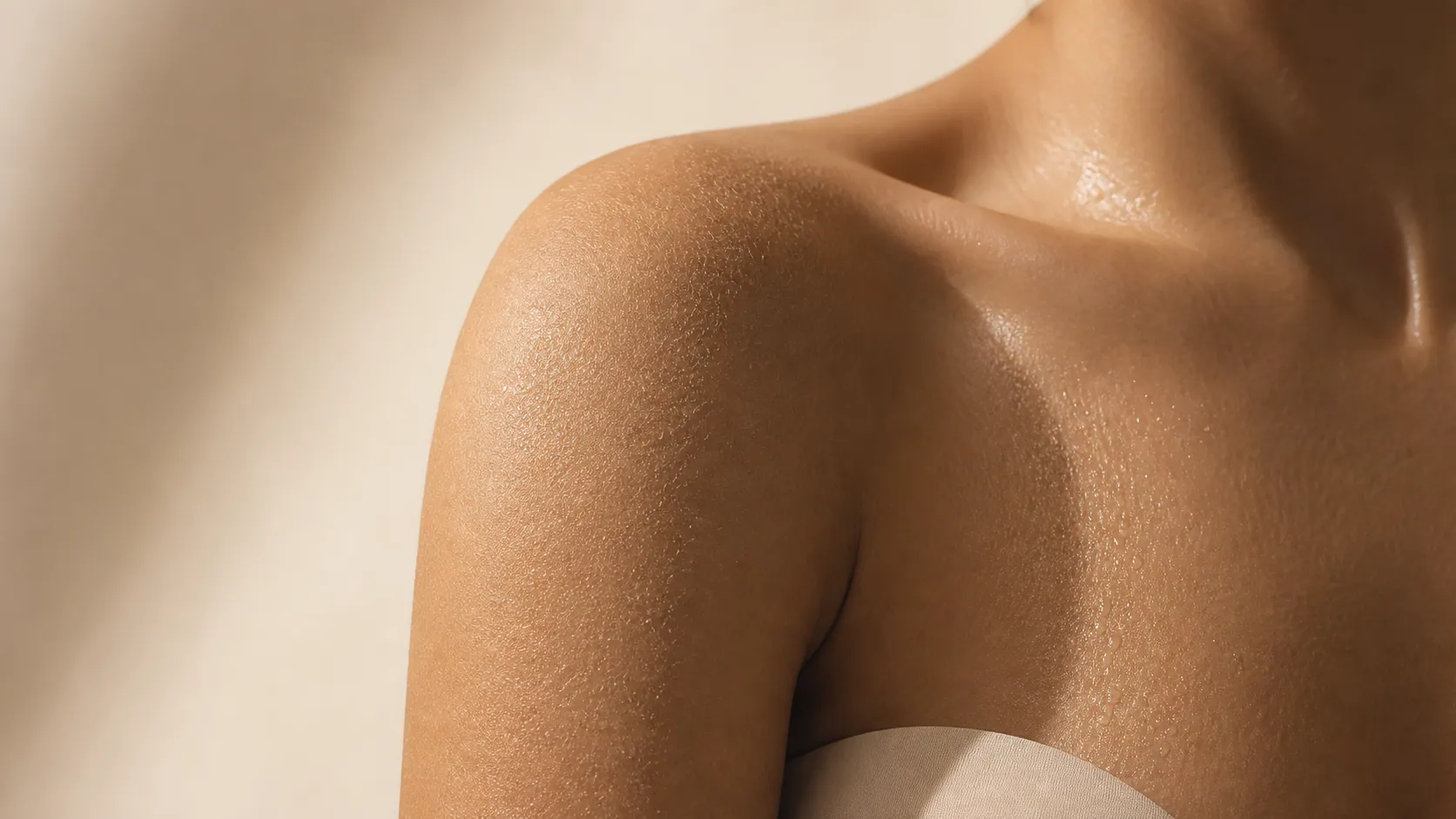
What Is Dry Body Skin?
Dry body skin is a structural condition. It means the skin barrier is deficient in lipids: the ceramides, fatty acids, and cholesterol that form the waterproof matrix between skin cells. When this lipid matrix is depleted, water escapes continuously through the surface. This process is called transepidermal water loss, or TEWL. The skin feels tight, rough, and dull not because it simply lacks water, but because it cannot hold the water it already has.
Body skin is naturally more vulnerable to this problem than facial skin. The face has a high concentration of sebaceous glands, which help replenish surface lipids. The arms, shins, and torso have far fewer. Zouboulis et al., Experimental Dermatology, 2008, measured fewer than 10 sebaceous glands per square centimetre on the lower limbs, compared to 400 to 900 per square centimetre on the face. Body skin cannot replenish its own lipid barrier the way facial skin can. Every shower removes some of the residual lipids that do exist. Without replacement, the barrier becomes weaker over time.
The fix for dry body skin is lipid replacement. Not more water alone. Not a lightweight lotion that disappears quickly. The barrier needs the raw materials it is missing: fatty acids, ceramides, and barrier-supporting lipids. This is where linoleic-rich oils matter. Linoleic acid helps support the synthesis of key ceramides involved in barrier repair. A linoleic-rich oil applied to body skin gives the barrier what it has been missing. A water-based lotion may feel hydrating at first. But if the lipid barrier remains depleted, the water escapes again.
What Is Dehydrated Body Skin?
Dehydrated body skin is different. It is a temporary condition, not a skin type. It means the skin is low in water, regardless of whether the lipid barrier is naturally dry, oily, or balanced. Dehydration can affect any skin type. It may be caused by low humidity, excessive caffeine or alcohol intake, inadequate fluid intake, over-exfoliation, or routines that disturb the skin's surface environment.
Dehydrated body skin can feel tight and look dull. It may show fine surface lines that become less visible when the skin is pressed or moisturised. The important difference is this: the barrier may not be the primary problem. TEWL may not be severely elevated. The issue is water content, not necessarily lipid loss.
The Pinch Test
There is a simple way to observe whether your body skin may be dehydrated. Pinch the skin on your inner forearm between two fingers, hold for two seconds, and release. If the skin returns quickly, water content is likely adequate. If it stays tented or returns slowly, the skin may be dehydrated. This is not a medical diagnosis. Skin turgor can be influenced by age, elasticity, and general hydration. But it can help you notice whether your skin is behaving like water-deficient skin rather than only lipid-deficient skin.
The fix for dehydrated body skin is humectants. Humectants attract water. Glycerin, hyaluronic acid, and aloe vera are examples. Applied to damp skin, they help draw water into the upper layers. But humectants need to be sealed. Applied without an occlusive or lipid layer, a humectant can pull water toward the surface, where it evaporates. For dehydrated body skin, the correct order is water first, then seal. A humectant draws water in. A lipid layer helps hold it there.
Why Most People Get This Wrong
The confusion is understandable. Dry body skin and dehydrated body skin can both feel tight. Both can look dull. Both can create discomfort after showering. From the surface, they can seem like the same problem. Brands use words like "moisturising," "hydrating," and "nourishing" as if they mean the same thing. They do not. Unless the product explains what problem it is solving, the consumer is left guessing.
"Most people with dry body skin apply more lotion. Most people with dehydrated body skin apply oil. Both may be solving the wrong problem with the wrong tool."
| Dry Body Skin | Dehydrated Body Skin | |
|---|---|---|
| Root cause | Lipid deficiency in the barrier | Insufficient water content |
| TEWL | Often elevated | Normal or mildly elevated |
| Skin type | More structural and recurring | Temporary and changeable |
| Common signs | Roughness, flaking, persistent tightness | Dullness, fine surface lines, tight feeling |
| Correct fix | Lipid replacement | Humectant first, lipid seal second |
| Wrong fix | Water-based lotion alone | Oil alone |
The cost of misdiagnosis is not just disappointment. It can keep the cycle going. Applying a heavy oil to dehydrated skin without a humectant underneath may smooth the surface, but it does not add water. The skin feels better briefly, then returns to tightness. Applying only a humectant to dry, lipid-deficient body skin may bring water to the surface, but the weakened barrier lets that water escape again. Both routines can feel like they work for a few hours. Neither repairs the actual problem.
Can Body Skin Be Both Dry and Dehydrated?
Yes. In bodycare, this is extremely common. The barrier may be lipid-depleted, while the cells are also low in water. One condition can worsen the other. A weakened lipid barrier allows more water to escape. Low water content can also interfere with the enzymes involved in normal barrier function and ceramide production.
This is why body skin often needs more than one step. It does not only need hydration. It does not only need oil. It needs the right sequence. Humectant first. Lipid second. The humectant addresses water deficiency. The lipid layer helps reduce water loss and supports barrier recovery. Rawlings and Harding, Dermatologic Therapy, 2004, describe this type of combined approach as clinically relevant for compromised skin: water-binding ingredients to attract hydration, and lipid support to help retain it.
The Correct Sequence for Body Skin That Is Both Dry and Dehydrated
Effective bodycare is not only about ingredients. It is about order. ANISSOU approaches body skin through a sequence: prepare, reset, recover. Each step creates the conditions for the next one to work. When the order is wrong, even good ingredients can underperform.
Step 1: Prepare
The skin's acid mantle helps maintain a surface pH around 4.5 to 5.5. This acidic environment supports the enzymes involved in healthy barrier function. Many body washes sit at a higher pH. Repeated use can disturb the acid mantle and make the barrier less efficient. A preparation step helps restore the right surface environment before treatment begins. Before body skin can recover, it has to be prepared.
Step 2: Reset
Body skin accumulates dead cells easily. Cell turnover is slower on the body than on the face, and the lower density of sebaceous glands means there is less natural lipid flow to keep the surface supple. When dead cells build up, humectants and oils do not absorb as effectively. A reset step clears this surface layer without stripping the barrier. Enzymatic exfoliation is especially useful because it can loosen dead cells while respecting the acid mantle. This is the step many bodycare routines skip.
Step 3: Recover
Once the skin is prepared and reset, recovery can begin. For body skin that is both dry and dehydrated, apply a humectant to damp skin first. Damp skin gives the humectant water to bind. Then, within one to two minutes, apply a linoleic-rich oil. The oil seals the humectant against the skin, helps reduce water loss, and delivers fatty acids the barrier can use as part of its repair process. The two steps are inseparable. A humectant without a lipid seal may evaporate too quickly. An oil without water underneath may soften the surface without correcting dehydration. Together, they address the full problem: water inside, lipids over it, barrier recovery over time.
For a complete breakdown of why linoleic acid is the specific fatty acid the body skin barrier needs, read: Prickly Pear Seed Oil: Why It Works Differently on Body Skin.
Why Linoleic Acid Matters for Dry Body Skin
Not all oils behave the same way on body skin. Some oils are richer in oleic acid, which can feel luxurious but may be too disruptive for compromised barriers when used alone. Linoleic-rich oils are different. Linoleic acid is one of the fatty acids involved in the skin's lipid structure. It supports the ceramide network that helps the barrier retain water.
Prickly pear seed oil is naturally rich in linoleic acid. This makes it especially suited to body skin that feels dry, rough, or unable to stay moisturised. For ANISSOU, the point is not simply to use a natural oil because it sounds beautiful. The point is to choose a hero natural ingredient because its composition matches the biological need of body skin. Then biotechnology can amplify the result: adding clean, consistent, targeted ingredients that support hydration, barrier function, and skin compatibility. Nature provides the hero. Biotechnology sharpens the result.
The Takeaway
Dry body skin and dehydrated body skin are not the same problem. Dry body skin lacks lipids. Dehydrated body skin lacks water. Many people have both. That is why one-step body moisturising often fails. It treats body skin as if every kind of tightness has the same cause.
Effective bodycare begins with diagnosis. Then it follows sequence. Prepare the skin. Reset the surface. Recover with water first, lipids second. Because body skin does not need more vague moisturising. It needs the right mechanism, in the right order.
Frequently Asked Questions
How do I know if my body skin is dry or dehydrated?
Dry body skin is usually rough, flaky, and persistently tight. Dehydrated body skin looks dull, feels tight, and may show fine surface lines. Dryness points to lipid deficiency. Dehydration points to water deficiency. Many people experience both at the same time.
Can oily body skin be dehydrated?
Yes. Dehydration is about water, not oil. Even skin that produces enough surface oil can lack water inside the upper layers. This is why oily or balanced body skin can still feel tight, dull, or uncomfortable after showering.
Why does my body lotion make my skin feel better briefly, then dry out again?
Most lotions add water and temporary softness. If your lipid barrier is depleted, that water can escape through elevated TEWL. The skin feels better at first, then returns to dryness because the barrier has not been rebuilt.
Is glycerin good for dry body skin?
Glycerin is good for dehydration because it attracts water. For truly dry body skin, it works best when followed by a lipid layer. Without lipids to seal and support the barrier, the hydration may not last.
How long does it take to repair dry body skin?
Surface comfort can improve quickly, but structural barrier repair usually takes consistent care over 2 to 4 weeks. Body skin needs repeated lipid support, gentle exfoliation, and hydration in the right order before lasting improvement becomes visible.
References
- 1. Rawlings, A.V. & Harding, C.R. "Moisturization and skin barrier function." Dermatologic Therapy, 2004. https://doi.org/10.1111/j.1396-0296.2004.04s1001.x
- 2. van Smeden, J. & Bouwstra, J.A. "Skin barrier function and its relation to the fatty acid profile." International Journal of Molecular Sciences, 2016. https://doi.org/10.3390/ijms17030360
- 3. Elias, P.M. "Skin barrier function." Dermatologic Therapy, 2005. https://doi.org/10.1111/j.1529-8019.2005.00040.x
- 4. Zouboulis, C.C. et al. "Frontiers in sebaceous gland biology and pathology." Experimental Dermatology, 2008. https://doi.org/10.1111/j.1600-0625.2008.00725.x
- 5. Lodén, M. "Role of topical emollients and moisturizers in the treatment of dry skin barrier disorders." American Journal of Clinical Dermatology, 2003. https://doi.org/10.2165/00128071-200304111-00002
- 6. Proksch, E. et al. "The skin: an indispensable barrier." Experimental Dermatology, 2008. https://doi.org/10.1111/j.1600-0625.2008.00786.x