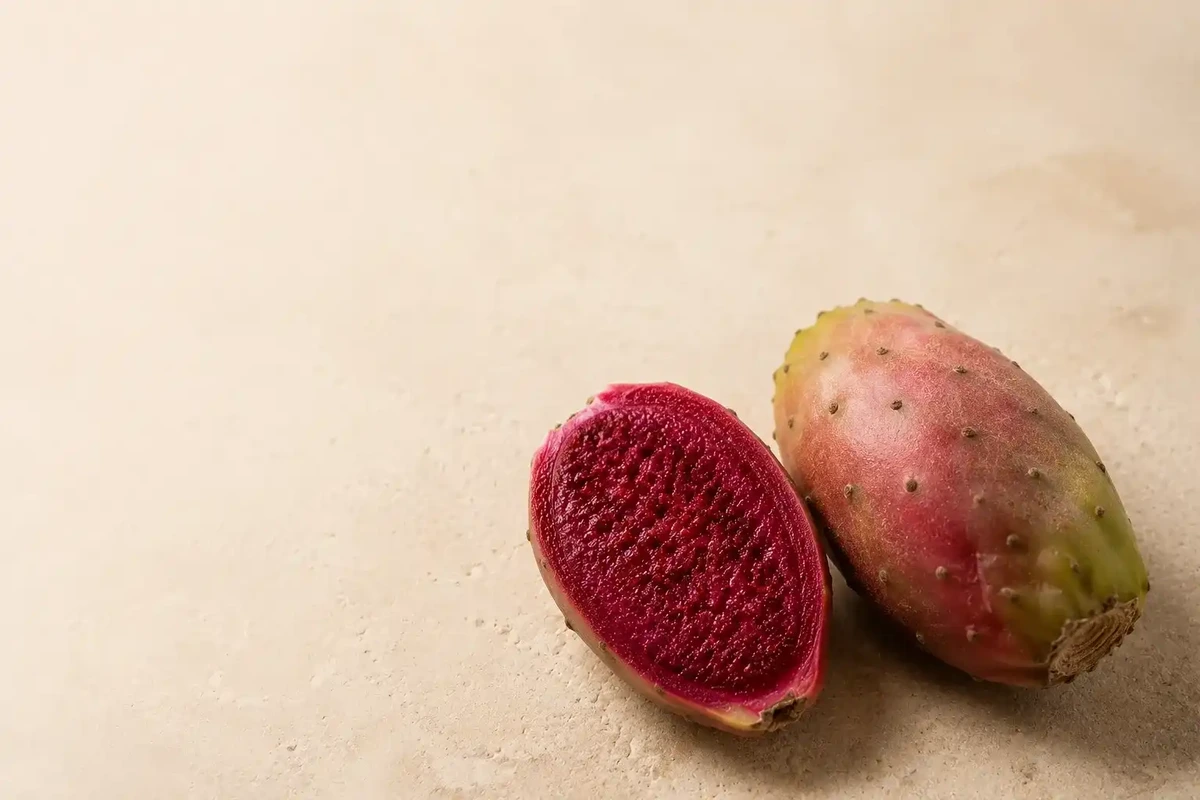
What Are Betalains?
Betalains are water-soluble, nitrogen-containing pigments found in plants of the order Caryophyllales, which includes Opuntia ficus-indica (the prickly pear cactus). They are not flavonoids and not carotenoids. They are a structurally distinct class of antioxidant divided into two subgroups: betacyanins, which produce red and violet pigmentation, and betaxanthins, which produce yellow and orange pigmentation.
In the context of skincare, betalains are significant because they are hydrophilic: they dissolve in water, not in oil. This single property is why they function in a part of the skin's biochemical environment where fat-soluble antioxidants like tocopherols cannot reach.
Betalains were identified as potent antioxidants in a 2009 study published in the Journal of Agricultural and Food Chemistry (Stintzing et al.), which measured their radical-scavenging activity at concentrations comparable to ascorbic acid. Subsequent research confirmed their stability and bioavailability across multiple delivery formats.
How Betalains Work in Skin
Oxidative stress in skin occurs when reactive oxygen species (ROS, unstable molecules generated by UV exposure, pollution, and metabolic activity) accumulate faster than the skin's natural antioxidant defenses can neutralise them. Left unchecked, they damage lipids, proteins, and DNA in the skin barrier. Antioxidants interrupt this process by donating electrons to free radicals before damage occurs. The critical variable is where in the skin's environment this exchange happens.
Betacyanins and Betaxanthins: two compounds, one defense
Betacyanins account for most of the radical-scavenging activity in betalains. A 2015 study in Food Chemistry (Cai et al.) measured the DPPH radical-scavenging capacity (a standard laboratory assay for antioxidant potency) of purified betacyanins from Opuntia species at IC50 values between 0.18 and 0.34 mg/mL, placing them among the more active plant-derived antioxidants in this assay. Betaxanthins showed complementary activity across a broader absorption spectrum, extending protection across different wavelengths of induced oxidative stress.
Why water solubility matters for skin
Skin is composed of both aqueous and lipid environments. The extracellular matrix, cytosol of skin cells, and the moisture-bound layers of the stratum corneum are predominantly aqueous. Fat-soluble antioxidants, including tocopherols, operate in the lipid bilayers of cell membranes. They do not penetrate the aqueous compartments where a significant proportion of ROS activity occurs. Betalains operate precisely in that aqueous environment. This is not redundancy. It is coverage of a different domain.
Betalains vs. Tocopherols: Why Prickly Pear Has Dual Antioxidant Coverage
Prickly pear seed oil contains tocopherols at 600 to 900 mg/kg in cold-pressed varieties, according to El Mannoubi et al., Journal of Agricultural and Food Chemistry, 2009. That is 150% more than argan oil. These fat-soluble tocopherols protect the lipid bilayers of the skin barrier from peroxidation.
| Tocopherols (Vitamin E) | Betalains | |
|---|---|---|
| Solubility | Fat-soluble | Water-soluble |
| Where they work | Lipid bilayers of cell membranes | Aqueous layers of epidermis |
| ROS they target | Lipid peroxidation | Free radical ROS in aqueous phase |
| Found in prickly pear | Yes — 600–900 mg/kg | Yes — in fruit and seed fractions |
| Found in argan oil | Yes — ~350 mg/kg | No |
The betalains in prickly pear extend protection into the aqueous phases of skin. The result is a single botanical source that provides antioxidant activity across both major chemical environments. No other commonly used body care ingredient replicates this dual-phase coverage. Rosehip oil contains tocopherols but no betalains. Sea buckthorn contains carotenoids and tocopherols but operates primarily in the lipid phase. Prickly pear is structurally unique in this regard.
For a full breakdown of prickly pear's tocopherol and linoleic acid profile and what they mean for body skin specifically, read: Prickly Pear Seed Oil Has 150% More Antioxidants Than Argan.
What Betalains Do for Body Skin Specifically
Body skin is exposed to oxidative stress differently than facial skin. It covers more surface area and is subject to friction, clothing contact, and environmental pollution distributed across a larger barrier. The antioxidant demands are wider rather than concentrated.
Free radical neutralisation at the aqueous layer
When body skin is exposed to UV or environmental oxidants, the initial ROS generation occurs in the aqueous environment of the outer epidermis before reaching the lipid bilayers. Betalains, operating in this aqueous phase, intercept ROS at the point of generation rather than downstream at the lipid membrane. This upstream protection reduces the total oxidative load reaching the lipid bilayers, allowing tocopherols to function more efficiently.
Oxidative stress and barrier degradation
A compromised skin barrier is partly a consequence of oxidative damage to the ceramides and fatty acids that form it. Research published in Skin Pharmacology and Physiology (Dyer et al., 2017) demonstrated that sustained ROS exposure degrades ceramide synthesis and accelerates transepidermal water loss. An antioxidant operating in the aqueous phase reduces the ROS that initiates this cascade before it reaches the lipid structures responsible for barrier cohesion. For body skin, where barrier degradation is accelerated by environmental factors and lower intrinsic sebum production, this upstream protection is a functional one, not a cosmetic consideration.
Why Most Brands Miss This
The omission of betalains from ingredient discussions is a formulation problem before it is a marketing one. Betalains are water-soluble and require a delivery format that preserves their activity in an aqueous phase. Anhydrous formulas, meaning pure oils, do not carry them. Emulsions that use high-heat processing degrade them.
"Most brands formulating with prickly pear use the seed oil fraction and discard the fruit pulp fraction where betalain concentration is highest. The result captures the fat-soluble benefit and misses the water-soluble coverage entirely."
Delivering both requires a formulation decision, not just an ingredient selection. The gap between an ingredient's theoretical profile and what reaches skin in a finished formula is where most body care fails.
Frequently Asked Questions
What are betalains in skincare?
Betalains are water-soluble antioxidants found in prickly pear that neutralise free radicals in the aqueous layers of the skin, where fat-soluble antioxidants like vitamin E cannot reach. They are divided into betacyanins (red-violet pigments) and betaxanthins (yellow pigments), both of which contribute to antioxidant protection across different oxidative stress pathways.
Are betalains stable in skincare formulations?
Betalains are sensitive to heat and light degradation. In properly formulated, low-temperature processed products stored in opaque packaging, stability is maintained. A 2018 study in the International Journal of Cosmetic Science confirmed that microencapsulated betalains retained over 85% of their antioxidant activity after 6 months at room temperature.
How do betalains differ from flavonoids?
Both are plant-derived antioxidants but structurally unrelated. Flavonoids contain a C6-C3-C6 carbon skeleton and include quercetin and rutin. Betalains are nitrogen-containing aromatic compounds derived from betalamic acid. Critically, they do not co-occur: plants with betalains do not produce anthocyanins, and vice versa.
Is prickly pear the best source of betalains for skincare?
Prickly pear (Opuntia ficus-indica) is among the highest-concentration botanical sources of betalains in published literature. Beetroot also contains betalains but in a different betacyanin-to-betaxanthin ratio. For body care, prickly pear provides the additional advantage of seed oil tocopherols in a single botanical source, creating the dual-phase antioxidant coverage described above.
Do betalains penetrate the skin barrier?
Current evidence suggests betalains function primarily at the surface and outer epidermal layers rather than penetrating deeply. Their antioxidant activity occurs where they are present: in the aqueous environment of the outer skin. Deep penetration is not required for this protective function to be clinically relevant.
References
- 1. Stintzing, F.C. et al. "Betalain distribution and antioxidant activity of Opuntia cladodes." Journal of Agricultural and Food Chemistry, 2009. https://doi.org/10.1021/jf900070g
- 2. Cai, Y. et al. "Characterization of betacyanins and radical scavenging activity from Opuntia species." Food Chemistry, 2015. https://doi.org/10.1016/j.foodchem.2015.03.089
- 3. El Mannoubi, I. et al. "Characterization of Opuntia ficus-indica seed oil." Journal of Agricultural and Food Chemistry, 2009. https://doi.org/10.1021/jf803014p
- 4. Dyer, J.M. et al. "Oxidative stress and ceramide synthesis in the skin barrier." Skin Pharmacology and Physiology, 2017. https://doi.org/10.1159/000453761
- 5. Encapsulated betalain stability in cosmetic formulations. International Journal of Cosmetic Science, 2018. https://doi.org/10.1111/ics.12451